


When discussing the beginnings of the women’s movement in Slovenia the conversation generally opens with mentions of intellectuals, writers, or journalists. Alongside them there emerged another, equally vocal and equally passionate group of educated and financially independent women: teachers. In the late 19th century, as one can discover also in Ljubljana Feminist Tour, female teachers already represented an integral part of Slovenian primary education, yet they remained undervalued and overlooked in schools, in the public sphere and also within their professional organisations. The female teacher’s struggle for equal and dignified pay reveals how a system of gender inequality was established within the field of education – it was not accidental, but rather a reflection of fin-de-siècle social norms.
In the late nineteenth century, the teaching profession was relatively accessible to Slovenian women from the middle and upper social classes, particularly after the establishment of the women’s teacher training college in Ljubljana in 1871. Teaching offered young women a degree of personal and financial independence that was, at the time, more an exception rather than the norm. Female teachers had the same education as their male counterparts: they could teach in equivalent positions, participate in the same professional organizations, and write for teachers’ journals. Nevertheless, their salaries were up to 20 percent lower than those of male teachers – not occasionally or exceptionally, but systematically. The question of pay thus became the central point at which inequality between female and male teachers converged.
This is also evidenced by the “Memorial” (“Spomenica”) published in 1897 in the teachers’s newspaper Učiteljski tovariš by the committee of the Slovene Teachers’ Association. In the table proposing teachers’ salaries, it was explicitly stated that female teachers in elementary schools should receive 150 florins less than male teachers, while female teachers in civic schools would receive as much as 200 florins less than their male colleagues. For female teachers, this newspaper article represented a turning point: they were confronted with openly and publicly expressed discrimination from their male colleagues, even though these same colleagues had previously emphasized the importance of mutual support and collegiality.

Male teachers interpreted the principle of “equal work – equal pay” in a way that reinforced their privileged position. They argued that they had more work duties, that they could serve as headmasters, that they taught across all grades, and that the law therefore assigned them a “more demanding and important task.” Female teachers responded to the “Memorial” with a clear articulation of their demands. One of them wrote: “We demand equality with our colleagues because it is our due.”
The gap between declarative support and actual practice was one of the key reasons for the establishment of the Association of Slovene Female Teachers in 1898. The issue of pay in particular revealed that the interests of female teachers were not protected within mixed professional organizations. An important inspiration for founding their own association was also the all-Austrian assembly of female teachers in Vienna on 8 August 1898. There, Slovene female teachers joined the protest against the deletion of certain articles of the school code that had explicitly guaranteed equal rights for female teachers.
In addition to the already mentioned arguments about the supposed inequality of men’s and women’s teaching work, an even greater structural obstacle to equal pay was the celibacy requirement imposed on female teachers. The ban on marriage for female teachers, enacted in 1869, was not merely an intrusion into private life but an important financial mechanism. Because female teachers were bound to celibacy, they were not allowed to have families; at the same time, the salary system was built on the assumption that higher wages were necessary for married men who supported their families. This placed female teachers in a paradoxical position: because they were not allowed to have families, they were considered less entitled to higher pay. Debates from the early twentieth century, however, show that in practice the difference between married and unmarried male teachers was often not taken into account—meaning that only female teachers actually received lower salaries.

Artcle »Why Did Slovenian Teachers Establish Their Own Association?« published in magazine Slovenka (The Slovenian Woman), vol 2, št. 11, p. 251 (21. 5. 1898).
In its first years of activity, the Association of Slovene Female Teachers addressed several petitions to the local authorities. In 1898 they requested salary improvements and succeeded in obtaining the possibility of easier advancement into higher pay grades, though with a clear limitation: their salaries remained 10 percent lower than those of their male counterparts. In 19000, when they demanded the restoration of this missing 10 percent, their request was rejected without explanation. They experienced another rejection in 1905, when they addressed the Carniolan provincial assembly with a demand expressed in a clear slogan: “Equal pay for equal work!”
The tangible difference in teachers’ salaries is also illustrated by statistical data published in Učiteljski tovariš in 1904. According to these figures, the average annual salaries of female teachers in Carniola (1,164 crowns) were significantly lower than those of male teachers (1,462 crowns), while as many as 124 female teachers were left without a regular income altogether. These figures clearly show that the differences were not merely symbolic but reflected a materially and socially more precarious position for women. Despite repeated rejections, female teachers persisted and continued to express their demands.
As part of their broader public activity, Slovene female teachers also addressed the issues of celibacy, pensions, and later the right to vote. Nevertheless, the struggle for equal pay remained the driving force of their emancipation. A dignified salary meant recognition of their education, their work, and their status in society. The activism of female teachers can thus be understood as one of the earliest forms of feminist practice in Slovenia. It was not a loud revolt, but rather a persistent and collective resistance against a system that declared women’s work to be less valuable then
Text by Lena Fidel
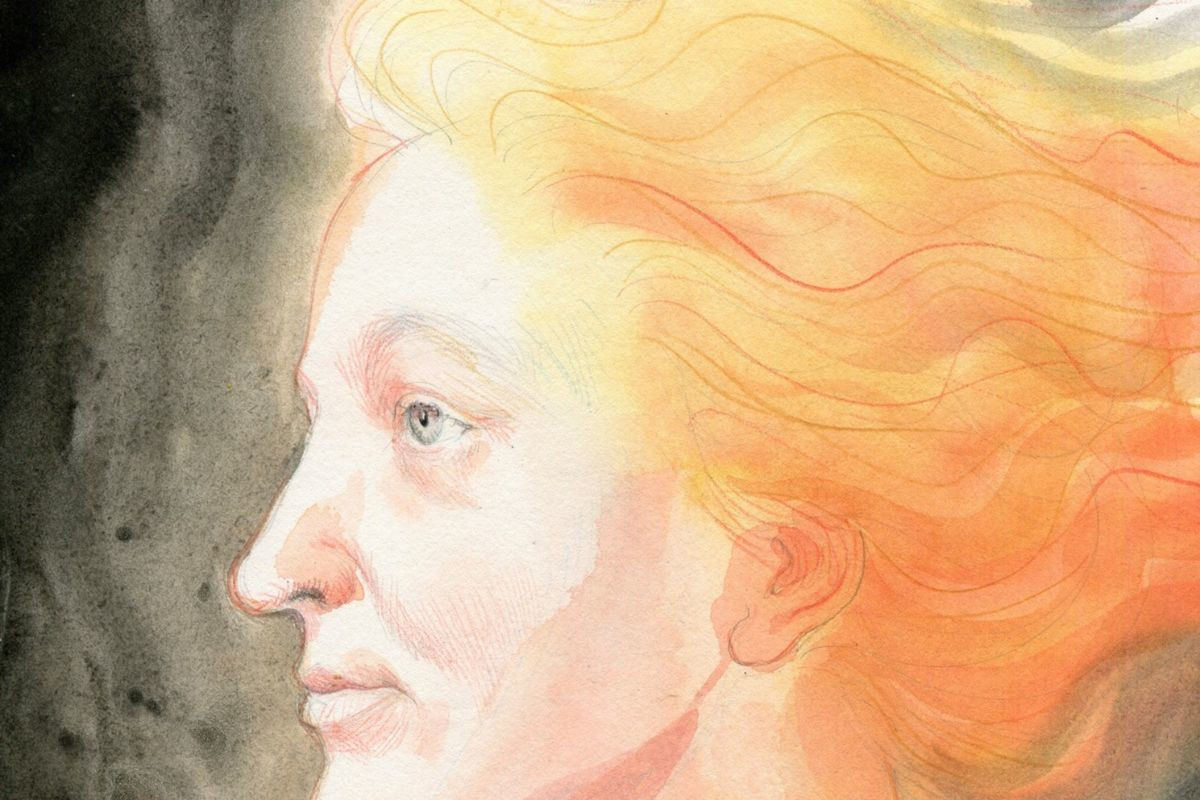
Cover illustration by Bojana Dimitrovski